Case Study | Wildly Important Goals and FHP Forward
In 2019, FHP’s CEO Shelley Ebenal had a wildly important goal: for every department in the hospital system to create their own Wildly Important Goals and use them to improve care. She’s modest about her vision. “ No vision here,” Shelley laughed, “I read a book, somebody else’s vision. I just liked it. Jen [Schuler, Director of Quality at Foundation Health Partners], on the other hand, has taken it to a whole new level.”
But at first, and without a structured management system, the program initially struggled to produce significant improvements or engagement.
As FHP began to work with the Virginia Mason Institute on a management system – what would become FHP Forward – the Wildly Important Goals program “jumped off the page,” says Robbi Bishop, Executive Partner for Transformation Services at Virginia Mason Institute, “they have this system where they engage every department in a goal and they work to improve that goal.” He says it was music to his ears – a match made in heaven. “We thought, oh my gosh, you have something here that most people don’t have. You have a language, you have a culture, you have an infrastructure.” They knew the program needed work, but it was the perfect place to start.
And, as Jen Schuler adds, “it’s all the same work. That’s the reality. It’s all improvement work,” and it’s an ongoing process that never stops. “It’s an ever evolving learning, and then truly meeting people where they’re at.”
Fall Prevention
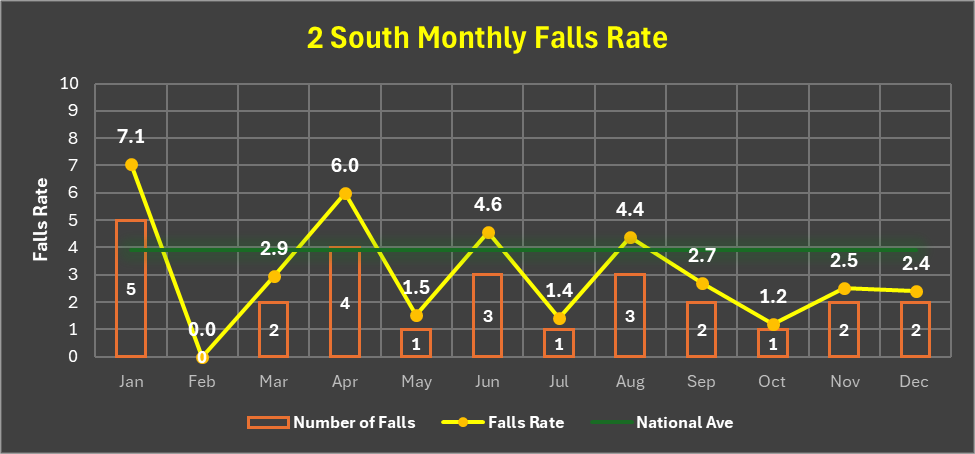
South 2 is an Acute Medical Unit at Foundation Health Partners. As anyone who has spent time in an inpatient facility knows, falls and fall prevention are always top of mind. Falls are one of the most adverse events reported in hospitals. They can result in increased injury, mortality rates, length of stay, and medical costs. In 2024, South 2 experienced falls slightly above the national average. In 2025 they decided on a Wildly Important Goal: to bring their fall rate below the national average.
As the unit turned their attention to falls, they used the PDSA (Plan, Do, Study, Act) framework to understand the current state, identify opportunities for improvement and to test their ideas for improvement. They realized that they had gotten out of the practice of counting ‘fall free days’ and started building them back into the shift change huddle.
“Being intentional about calling out how many days we’ve been without a fall, creates that daily awareness, kind of keeps it on the forefront of people’s minds,” said Caleb Humphrey, Med Surg 2 South RN Sr. Manager. “Obviously on a nursing unit there’s a lot of things you’re juggling. There’s a lot of different things you’re trying to focus on. So how do we keep this paramount throughout the year?”
Another important addition to their process was the post-fall huddle: any time a patient falls, the team gathers to debrief and identify what happened, and what they could have done differently.
“ How do we take the lessons learned and how do we spread them across the team?” said Humphrey, “because things like falls are never black and white, right? There’s always a lot of nuances to them because you’re dealing with an individual, you’re dealing with a patient, you’re dealing with the complexity of their diagnosis, you’re dealing with the environment. And so it’s never quite algorithmic or like, ‘do this, don’t do this.’ And so how do you create the critical thinking for all the complexity that goes into a fall?”
Another major revelation had to do with equipment. Safety equipment like seat belts, walkers, and wheelchairs can have a massive impact on fall prevention. But before the team adopted this WIG, much of the equipment was being stored in a central location. When a patient rang for help to go to the bathroom, the nurse would have to choose between helping that patient right away, or walking across the unit to retrieve a piece of equipment that would make the bathroom visit safer. Now, each room has a simple bracket that allows nurses to store a walker inside the patient room.
The 2025 WIG was a great success for South 2: their goal had been to bring their fall rate from 4.6 to 3.9 [falls rate = (Number of Falls/Total Patient Days) x 1000], but by the end of the year they had sailed all the way down to 3.0.
Laundry
Hospitals process an enormous amount of laundry. Foundation Health Partners does 5,000 pounds of laundry per day. Sixty percent of that is done on “small” 100 pound washing machines (for scale, that’s ten times the size of a typical ‘large load’ on a home washing machine), and the rest is done in large loads of 200 pounds. Clean laundry is processed on folding equipment and then loaded onto delivery carts to be distributed throughout the hospital. If an item isn’t folded correctly, or a cart isn’t loaded properly, it can lead to a lot of waste of time and processing. Improperly folded items might have to be redone by hand; a messily loaded cart can’t carry as much and will lead to extra trips.
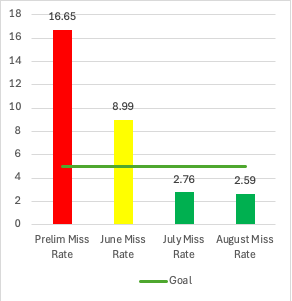
In early 2025 the laundry team was experiencing a “miss rate” of 16.65%. This was how frequently an item was mis-folded, damaged, or placed in the wrong sizing stack.
“Everybody knew this was a problem, but nobody really wanted to accept that. We all contributed to it,” said Shawn Lewis, Laundry Lead at Foundation Health Partners.
For the laundry team – 17 people working different shifts, speaking different languages, and having many different lengths of tenure at the hospital – coming together to gain a shared understanding was the biggest challenge to their work towards their WIG – and it offered the greatest reward.
Lewis spent time talking with everyone on the team about the challenges they were facing. “And I just said, ‘Hey, you know what, what do you guys think? Like if we, if we had one thing that we all needed to work on, what would you say it is?’ And across the board, every single person said, ‘well, the quality’s an issue.’”
It took time to get to that team-wide shared understanding of the issues. But once they got there and started to use zero in on their WIG and use FHP Forward principles to close their quality gap, the results were dramatic. From a baseline ‘miss rate’ of 16.65 in May, the team dropped to 8.99 the very next month – and blasted past their <5% goal in July. In July and August the miss rate was down to 2.76 and 2.59.
Takeaways
In 2 South and Laundry alike, teams experienced the power of setting a Wildly Important Goal – and of using their structured management approach of FHP Forward to analyze the current state, identify opportunities for improvement and test their ideas using the PDSA framework.
FHP now hosts an annual ‘Gallery Walk’ for teams to share their learning and thinking on Wildly Important Goals.
”We weren’t sure how it was going to go with the presentations,” said Jen Schuler of last October’s event, but she says they got great feedback from frontline staff who came to present to the executives. They told her, she says, how empowered they felt as a result of that. That their senior leadership team cares about the work that they’re doing.”
Next year the event will expand from one day to a full week to meet the growing appetite for sharing successes – and challenges. CEO Shelley Ebenal says the most recent day of presentations was an ‘aha moment’ for her.
“ I was so excited to see how excited everybody was. That had not been the case before. People were so excited to tell you about their WIG and what they had done, and even the WIGs that weren’t super successful, they were excited to tell you about what they learned, why they weren’t successful and what they were going to do differently.”