

But people aren’t cars!
How Virginia Mason became one of the first hospital systems to use the Toyota Production System for healthcare
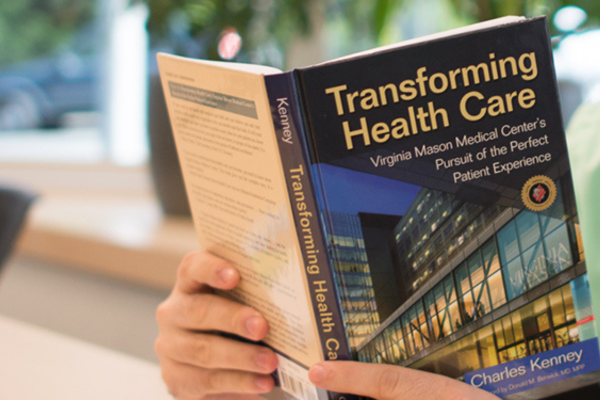
Welcome to our blog miniseries: Transforming Healthcare, featuring some of the biggest takeaways from the book Transforming Health Care: Virginia Mason Medical Center’s Pursuit of the Perfect Patient Experience.
Change or Die
In the early 2000s, Virginia Mason was in a financial crisis. They weren’t alone – the whole industry was struggling. Hospital leadership was also increasingly concerned that quality of care was not at the level they wanted it to be. Something was going to have to change…but what?
Dr. Gary S. Kaplan was the new CEO. He and others in the organization had always thought of itself as patient-centered, but as Kaplan began to deepen his understanding of how the organization was operating, he realized that it simply wasn’t true.
“The natural trajectory of the profession and the industry, first of all, was not one to look outside of itself,” says Kaplan in Transforming Healthcare. “So one construct is all we really had was ourselves to benchmark against and when you don’t look outside, you don’t necessarily see what’s possible….And if you don’t understand the current state and, even worse, you don’t know that you don’t understand the current state, it becomes limiting and you don’t think about something that ties it all together.”
Kaplan wanted to learn from other hospitals. Perhaps other systems had built a model that Virginia Mason could adopt to truly serve its new mission, which put patient care above all else.
“We were looking for ideas around innovation, around quality, safety and economics,” he says in the book. “I wanted ideas that we could steal, shamelessly, that would help us. But what I found was that there was no method to get there. We realized that nobody had a management method in health care to achieve this.”
The Airplane Conversation / Airplane Serendipity / Serendipity on an Airplane
But then Mike Rona, then president of Virginia Mason, happened to meet John Black on an airplane. ‘Lean’ manufacturing was gaining in popularity in many industries in the early 2000s, and Black told Rona about the Toyota Production System (TPS) and the transformational effect it had had at Boeing.
Assembly time for the 737 had been cut in half – from 22 days in 1999 to 11 days in 2005. Defects in production had been reduced 35 percent. Lean manufacturing had dramatically reduced the floor space needed for operations and reduced the amount of inventory kept on hand.
These are impressive improvements, to be sure, but what did auto manufacturing have to do with healthcare? Mike Rona and Gary Kaplan started to learn more.
Eliminating waste is the basis of the Toyota system. But it’s not just about wasting physical items. There are seven different types of waste: of time, motion, inventory, processing, defects, transportation and overproduction. In healthcare, “waste of motion” might happen when a nurse has to go off in search of supplies that could be kept readily at hand. “Defect waste” can happen when faced with doctors’ famously illegible handwriting. “Processing waste” might mean generating a report that has become obsolete.
‘“By eliminating waste, you improve quality, safety and reduce cost,” Kaplan observes in Transforming Healthcare. “When you eliminate waste, you create repetitive processes that can easily be standardized.”
Eliminating waste maximizes the value of every dollar spent on care.
Another core principle of the Toyota system is standardization, which can lead to a reduction in defects. Dr. Kaplan was beginning to see that, if TPS could effectively be applied to healthcare, it could offer the chance for Virginia Mason to improve quality and cut costs – an exciting possibility indeed.
Kaplan assigned a couple of teams to engage in Rapid Process Improvement Workshops, one of the key TPS tools.
They were thrilled with the immediate results: reducing the number of surgical instruments on the laparoscopic setup from 74 to 58, and cutting patient wait time by 69 percent. They achieved an annual savings of $26,880.
Kaplan was convinced, and began encouraging other members of his team to study the TPS. As they deepened their understanding of the model and began to comprehend how it could apply to Virginia Mason, a major insight became crystal clear: the challenges the hospital system was facing were not about commitment, competence, or resources. They were process problems. And they were starting to see how to address them. But in order to truly understand what might be possible, they knew they needed to see TPS in action. It was time to visit Japan.
A Study Trip to Japan
As plans took shape for a group of 30 top executives from Virginia Mason to take a two week long trip to Japan to study the Toyota Production System, many were skeptical. In June of 2002, The Seattle Times wrote, “for the past year, Virginia Mason Medical Center has been nipping and tucking to cut costs, so employees wonder why the hospital is paying for executives to go to Japan to learn to think lean.”
But Kaplan believed the trip would be more than worth it. And almost immediately, the executives were deeply inspired by what they witnessed. In their first dispatch home, they wrote:
“Toyota has perfected a set of tools and techniques that are applicable to any industry. There is not a single principle utilized to produce the highest quality automobiles that could not be applied to health care and to our processes at Virginia Mason”
One remarkable observation was that even the Virginia Mason team, medical professionals with no experience in industrial manufacturing, were immediately able to contribute to process improvement. Their dispatch continued:
“What impressed us was the ease with which we could understand a totally ‘foreign’ process, implement changes right away and see them work. We were stunned at the willingness of management to apply changes within minutes. Our teams would show the workers how we thought the work should change; they would retrain on the spot if possible and try it ….In one situation, the suggestion of placing parts on a higher platform eliminated bending over and picking up heavy parts hundreds of times a day for just one operator!”
The team came to understand that manufacturing and healthcare had more in common than they’d first thought. In another letter home they wrote: “Each of the products they produce has thousands of processes involved and many are very complex. Many of these products, if they fail, can cause fatality. They are in many ways, just like us.”
But this work did not ‘just happen.’ The executives came to understand that continuous improvement must be infused into every element of process, operations, and organizational culture. They observed that supervisors worked right on the genba (the shop floor), alongside line workers so they could communicate directly rather than via email or telephone. Team meetings happened at tables and chairs on the factory floor – not far away conference rooms.
The Virginia Mason group was able to witness what it looked like for kaizen – continuous incremental improvement – to be the fabric of every aspect of the work. As Kenney writes of the trip: “Toyota had succeeded in fostering a corporate culture that enhances individual creativity and teamwork while honoring mutual trust and respect between staff and management.”
The team returned to Seattle invigorated by the possibilities, but for some, it was simply too much change. While many embraced the change, some staff and physicians left for other hospitals, and others wanted to ‘wait and see.’ But as Kinney reports, Kaplan did not want anyone to ‘wait it out.’ He insisted on active engagement.
“If you want to be a senior leader here,” Kaplan told colleagues, “you have to be certified, which means you have to go through the certification training, take the exams, and continue to be certified to hold your job as an executive.”
Certification required a serious investment: seven days in the classroom and plenty of additional study – in addition to existing responsibilities. But the resistance soon gave way, as managers were able to almost immediately apply the learning to their everyday work – and get results.
An idea began to take shape: an adaptation of the Toyota Production System could become the Virginia Mason Production System. The idea was not to adopt the TPS wholesale, but to gain a deep understanding of its principles and apply them to healthcare. They knew the work would not happen overnight.
“Everyone was telling us that this takes twenty years,” says Kaplan, who was under pressure to make improvements immediately. But, he said, it was not long “before you realized that this is incremental and really a long-term strategy. So early on you’re hopeful that you’re going to see some really significant wins, but people said you’re going to be in it for the long haul. Given the unacceptability of the status quo in terms of quality, safety, cost, workforce satisfaction … there was no better option.”
With their work cut out for them, Kaplan and the Virginia Mason team embarked on what would become a new era of sustainable improvement – and transformation.
This post is based on the book Transforming Healthcare: Virginia Mason Medical Center’s Pursuit of the Perfect Patient Experience. You can find the book online https://a.co/d/09nWpGo


