Case Study | Reusable Badge Hats at NHS Somerset
Miscommunication in an operating room can be deadly. On any given day, dozens of people might be present for a procedure: the patient of course, surgeons, nurses, anesthetists, assistants, students, and even medical reps. Traditionally each of these people might have a lanyard with their name and role listed – but inside the sterile field that name badge is likely under a sterile gown. Even during interactions in patient rooms, personnel often tuck their badges into a pocket to keep them out of the way.
When Danielle Checketts was at UHCW hospital delivering her second child in 2020, Theatre Manager Liz Fitzhugh asked her to write her name and role on her hat. “it had a profound impact on me,” said Checketts, who has worked in operating theatres in various capacities for over twenty years, “and each time I’ve been in there, I’ve always not known who’s who. And always been mistaken myself as to being somebody else.” She says it was a huge ‘aha moment’. “I thought: what a fantastic way to improve communication, patient safety, and also sustainability.”
Fitzhugh had gotten the idea from the Australian Theatre Hat Challenge, where an anesthetist had written his name on his hat. “To patients who come through, we all look anonymous. And so to have your name on a hat that a patient can see, they can call you by that name, but if you have your role on as well, they can also see the medical team that’s looking after them.” Fitzhugh says that being able to clearly see at a glance who is in the room can save lives. “There have been situations where there is an emergency and someone shouts, ‘go and get me the crash trolley!’ No one goes or everyone goes. Now if you have a name on your hat and you hear, “Liz, go and get the crash trolley!” I’ve got a clear direction of what I need to do.”
Not only would reusable hats improve communication, there was great potential for environmental impact.
“We were getting through hundreds of thousands of hats a year and they were being thrown away,” said Fitzhugh. “They go into clinical waste, which is processed through a high treatment process. So we were burning them and they were adding to pollution in the environment…it wasn’t a lot of money financially, but we were throwing away hundreds of thousands of hats.”
Putting great ideas into action
For both Checketts and Fitzhugh, it was immediately clear that adding names and roles to surgical hats was the way forward. Now the challenge was: how?
“Unfortunately, when we started it, nobody was making hats in the UK,” said Fitzhugh. “There was a big space in the market. There was one poor lady in Birmingham who was making them in her garage.”
Checketts, who had her own medical consultancy firm, came up against similar barriers. Very few companies were producing reusable embroidered hats, “and the ones in Australia that were getting them from China and then sending them to the UK wasn’t very good for the carbon footprint.” She had never quite imagined starting up her own company but eventually she realized it just might be the only way to make it happen. She went into business with her brother Neil, and Eco Ninjas was born.
Both Eco Ninjas and UHCW started out using embroidered hats. They did the job of quickly identifying people by name and role, but it quickly became clear that there were inefficiencies. Each hat needs to be fitted to each individual. And if that person leaves, gets a promotion – or makes a significant change to their hairstyle – the hat becomes outdated and must be scrapped.
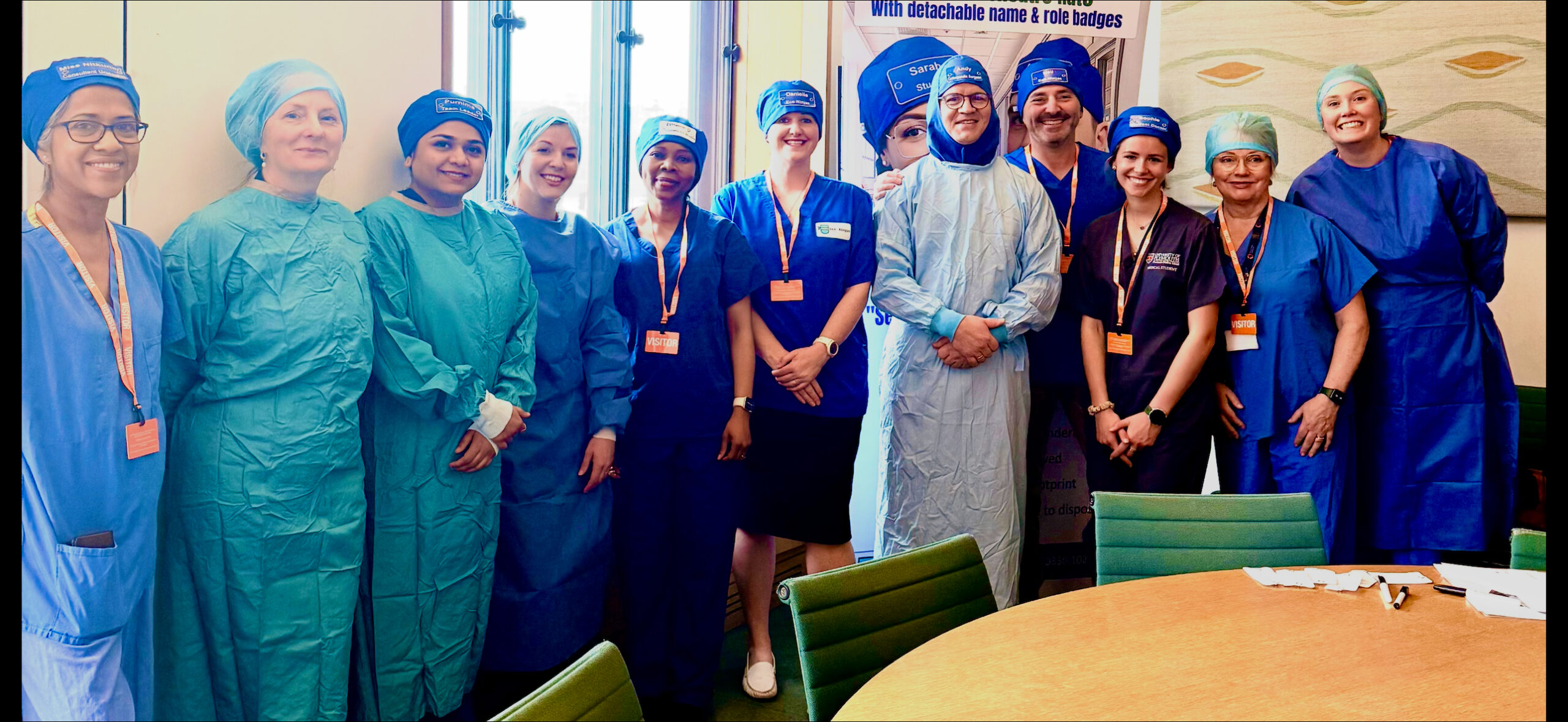
“We knew that there had to be a better solution to make it more scalable,” said Checketts. They developed a system of detachable polyurethane badges that can be attached to a hat with simple snaps or press studs. At the end of the day, the badge is removed and the hat is laundered right alongside hospital scrubs. The polyurethane badges are cleaned with soap and water or a detergent wipe, and ready for use again the next day.
Eco Ninjas has also developed additional designs for its hats to meet the needs of a range of hairstyles and cultural needs. One style covers the shoulders and chest for people who wear hijab. Another is designed for people who wear hair braids – a pouch of the back of the hat covers the braids and supports them to prevent traction alopecia.
“It’s just such an amazing and simple idea that does so much for so many people,” said Chris Backous, Executive Partner for Transformation Services at the Virginia Mason Institute. “What I like about that is you’re not just someone in the room. You’re a person who has a role and you have a name, and I can just imagine what that does for building teams.”
Another innovation has been to use color coding to identify roles. “As the theatre manager I could walk into theatre and see we have a team leader, I could see we have three registered practitioners, and I could see we have our support staff as well as an anesthetist and surgeon because they all wear different colored hats,” said Fitzhugh, who manages 36 different operating theatres.
There is an upfront cost for Hospital Trusts making the shift to reusable hats. Year one tends to cost about the same as using disposable hats. But by years two and three Somerset identified a 48% cost savings compared to disposables.
Healthcare is about people caring for people
Identifiable reusable hats have created significant improvements in efficiency and environmental impact, but human connection is at the heart of it all.
“As a student nurse, you get given jobs to do and roles to do, it’s really daunting. You end up hiding thinking, ‘oh, don’t ask me.’ You start diminishing your role by saying, ‘I’m only a student. I’m only a student.’” said Checketts, adding that once people know you’re a student everything changes. People suddenly start saying, “‘oh, come over. You are here to learn. Would you like to know this? Are there any questions you have?’”
“This is about people caring for people,” said Chris Backous of the movement towards identifiable reusable theatre caps. “Our identity is not just our role or our place in the organization, it’s also our name. And those things like hair braids and hijabs, that help us maintain our identity and build that respect amongst our teams.”
And, as Fitzhugh says, it’s hard to underestimate “how beautiful your name sounds when you, when you hear it.”
Learn More