
Looking at the value stream and identifying waste to improve quality and reduce costs - without losing revenue
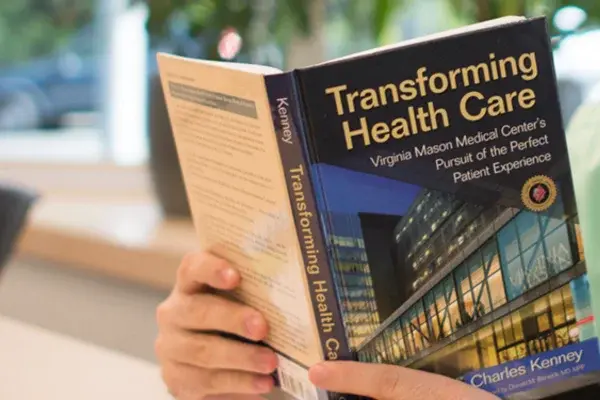
Welcome to our blog miniseries: Transforming Healthcare, featuring some of the biggest takeaways from the book Transforming Health Care: Virginia Mason Medical Center’s Pursuit of the Perfect Patient Experience. You can find the book online [here].
In 2004, Virginia Mason found an opportunity to improve healthcare in the unlikeliest of places: a contract negotiation with an insurance provider. The Aetna Aexcel Performance Network was in the process of selecting providers for their network serving large companies such as Starbucks, Costco, Alaska Airlines, and others. They were seeking only high-value providers: high quality at reasonable cost. Aetna had done an in-depth analysis on cost data, and their study had revealed that Virginia Mason was more expensive than its competitors in a number of specialties, including gastroenterology, neurology, and cardiology. Without a dramatic change, Aetna would let its contract with Virginia Mason expire, and it would be excluded from this exclusive network of high quality, high value providers.
Dr. Robert Mecklenberg, Chief of Medicine at Virginia Mason at the time and an enthusiastic champion of the Virginia Mason Production System (VMPS), was determined to keep Virginia Mason in the network. Exclusion could be a significant financial loss for the hospital system.
Mecklenberg didn’t yet know how they would be able to bring costs down significantly while maintaining high quality and keeping patient care as the top priority, but he knew that the VMPS could help him find the way.
Identifying the customer - and their needs
In healthcare systems, it can be rare for providers to interact with insurance companies - in fact, the two groups tend to find themselves at odds with each other. For Mecklenberg, the first step in understanding the challenge ahead was bringing together both benefits managers and medical providers. It was an opportunity for the providers to understand the cost data that was threatening their position in the Aetna network, and for the providers to get a glimpse into Virginia Mason’s culture of patient-centered care and continuous improvement. Those conversations revealed a disconnect: while at Virginia Mason there was now a strong culture of putting patient care above absolutely everything else, the team came to realize that the benefits managers were also very important customers. Without them, the hospital system would risk losing their primary customer - patients.
Another surprising realization emerged from these early conversations: for many of the employers, there was a single, relatively simple health concern that was a major need among their employees. For one employer it was migraine headaches, for another it was gastro-esophageal reflux disease (GERD). At Starbucks, back pain was a major issue: a common ailment for workers who spend their days on their feet.
As the providers heard the list of routine complaints they made an important realization: the cost challenges were not related to the specialty care needed for rare diseases or major health conditions. The Virginia Mason team saw an opportunity: focus on a common ailment such as back pain and use the VMPS to improve efficiency and quality of care.
Waste in the Value Stream for Back Pain
The Virginia Mason team mapped out a value stream to reveal what happened for a typical back pain patient, and revealed that the process was rife with waste and inefficiency. The phone lines were slow and it often took weeks or even months for patients to get an appointment. While waiting, patients often found themselves in pain, sometimes with limited mobility and a reduced ability to work, and almost always facing a strain on mental health.
Patients with back pain might enter the process from many different angles - from primary care or a specialist, a referral for an MRI - and along the way they faced long waits between each step. Looking at the value stream, doctors quickly identified that they needed to define the difference between complicated and uncomplicated back pain. While complicated back pain might require an MRI, surgery, or other complex treatment, uncomplicated back pain could often be addressed most effectively with physical therapy – and the sooner the better.
The team hit on an idea: knowing that physical therapy was the key to treating most uncomplicated back pain, could they find a way to get patients directly to physical therapy, without waiting for unnecessary tests and provider visits, all the while facing a worsening condition?
They determined that an extended initial appointment with a physical therapist, coupled with a short visit with a doctor, could help both ensure that patients were correctly diagnosed with uncomplicated back pain, addressing their anxiety, and immediately offering the physical therapy that would set them on their way to recovery. It required a culture shift, and the same challenges inherent to creating the space for same-day appointments that we saw in the previous chapter, but the change immediately transformed patient care in the spine clinic, allowing them to treat more patients, more quickly – and at lower cost. After a year, waiting time was cut from 31 days to same-day, and 94 percent of patients were returned to work that day or the next. Most cases did not require prescription medication, and patient satisfaction was stellar.
For Mecklenberg and others on the team were overjoyed at the success – and this work had revealed for them that they would find massive waste in Virginia Mason processes at other units throughout the hospital system. The work of continuous improvement would, well, continue - because better never stops.