
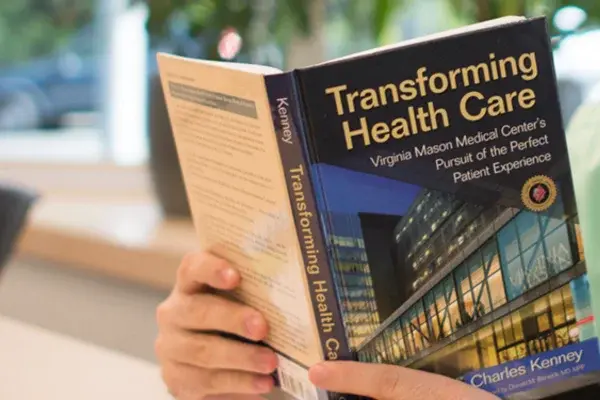
Welcome to our blog miniseries: Transforming Healthcare, featuring some of the biggest takeaways from the book Transforming Health Care: Virginia Mason Medical Center’s Pursuit of the Perfect Patient Experience. You can find the book online [here].
To a patient, getting care at the hospital can sometimes feel like a mystery. Going in for a surgery you might check in in one place, move to another room to change into a gown and check in with a series of providers, move to another room for the operation, and another still when it’s time to wake up. You interact with many different providers, from administrators to nurses to doctors, but you often have no idea what’s going to happen next, how far you will have to travel, or when it will be time to go home. Many hospitals and clinics are designed to suit the needs of providers - which makes sense, it’s their place of work - or even to work with whatever existing architecture is available. In its many decades long journey to transform healthcare, Virginia Mason has found that building a strong and dedicated focus on the patient experience, through intensive dedication to continuous improvement, can have astounding benefits for safety, patient experience, and the bottom line.
Ambulatory Care - Managing ‘the junk’
Before embarking on its VMPS journey, Virginia Mason’s Kirkland Clinic faced many of the same challenges seen at primary care clinics nationwide: long wait times for appointments, a frustrating phone experience, and long hours of paperwork for providers at the end of each shift.
The first change was perhaps the scariest: reducing the wait time for patients to get appointments would mean a dramatic change to scheduling: starting each day with only half of available appointments already booked. But a careful review of patient demand seemed to indicate that enough patients would call each day looking to book a same day appointment that the team - after several months of overtime to work through the patient backlog - arrived at the goal. Patients were delighted to be able to see their providers as soon as the very day they called in, and the clinic was able to fill those empty appointment slots.
Next came ‘the junk.’ Every day, physicians must plow through so much work outside of the time they get to spend one on one with their patients. They must do ‘indirect care’ - managing prescriptions, ordering lab tests and reviewing results, providing referrals to specialists – and they must manage a flood of true ‘junk’ such as advertising and promotions and spam email. Clinicians were averaging about three pieces of indirect care for every patient they saw in a day. Most often, they would leave this indirect care until the end of the day and take care of it all at once. That seemed to keep that ‘junk’ work from interfering with patient care – but typically meant staying on for long hours after patient visits were done for the day. The Kirkland Clinic created ‘flow stations,’ and paired each physician with a Medical Assistant who could manage the flow of indirect care, curating a few items to take care of between each patient visit. This not only allowed the doctors to stay on top of indirect care needs throughout the day and finish their shifts on time, but it also made better use of the Medical Assistants’ expertise.
Neither of these changes took place overnight – and the system takes constant care and attention to maintain. Medical Assistants in this role must be skilled at managing and collaborating with doctors. But when the system works, waste disappears, patient care happens more efficiently, and the whole team is able to finish their work at the end of their shifts and go home to their families.
Procedural Care - “You can’t do that!!” Or can you?
In hospitals, space is almost always at a premium. It can often feel like there are never enough patient rooms, and the pressure can be even worse for complex facilities like operating rooms. Around 2007, a Virginia Mason Production System team led by Robbi Bishop set out to reduce the amount of time it would take to turn over an operating room between procedures – from the already quite respectable 30 minutes to under ten minutes. It was an intimidating task, but at this point the team was well into its continuous improvement journey, and while they did not know what they would find, they felt confident they would be able to identify some mental valleys - typical or traditional ways of thinking that feel like immovable fact, but may actually be ripe for transformation.
The team had no interest in reducing the amount of time for surgical procedures themselves: they focused solely on all of the preparation and transition work that needed to be done before and after any given operation. They started by identifying some of the most time consuming elements of the existing turnover time: patient transfer and positioning, and setting up the specific surgical equipment needed for a given procedure. The thinking had always been that both needed to happen inside the operating room, but the team quickly realized that this might be a mental valley. Why couldn’t they position the patient at an earlier point in the process, prior to even entering the OR? They found that there was already a specialized bed on the market designed to do just that, allowing time to prep and position the patient precisely - before rolling them into the OR.
Preparing the surgical instruments seemed it might be trickier to solve. That prep must happen in sterile space, and had traditionally been performed inside the OR. But here the team hit on a significant innovation: they could create a separate sterile room adjoining the OR, with its own air filtration and intake, allowing a surgical technician to prepare the instruments for the next procedure while the previous one was taking place. This was new even for the Washington Department of Health (DOH) - for everyone involved there was a feeling of “you can’t do that!!” - but after careful review of the proposed design and in discussion with the DOH they realized that this new design idea was perfectly safe - and a huge opportunity to save precious turnover time for the operating room.
Inpatient Care - The Magic of Maximizing Time at the Bedside
Nurses are at the front lines of care in any hospital environment, but in the early 2000s, as part of its work to center the patient in every aspect of its work, Virginia Mason discovered that many of its processes were keeping nurses away from those frontlines.
A first challenge identified and tackled was simple distance: nurses were spending far too much time walking back and forth along long hallways to different patient rooms, or heading off in search of simple supplies such as saline syringes, medical tape, and mouth swabs. One department first made a simple change: assigning nurses to a cluster of cases all physically located close to one another, allowing the nurse to stay closer to their assigned patients. The search for supplies was also a relatively simple fix: each room was equipped with a clear plastic box containing those most-often needed supplies. No more running down the hallway to search for something as simple as a plastic syringe or a gait belt.
But there was still a desire to do more to maximize the amount of time nurses could be doing their most valuable work: spending time at the bedside, proactively supporting patient needs rather than having to react to calls for help. The team had been doing patient handoff in a conference room, separate from patients, which would not only keep the nurses off the floor for an hour or more, but necessitate additional time for the new nurse coming on shift to go around and meet the day’s patients after handoff. Shifting handoff to happen in each patient’s room was transformative: it not only removed that repetitive round of work, but it also allowed the patient and their family members to participate and have a clearer insight into their care team and care plans.
Another major innovation for this inpatient unit was hourly rounding. Proactively rounding on each patient each hour, and asking a very specific question: Are you comfortable? Has made a significant difference in catching things like increasing pain or discomfort, or needing support to go to the bathroom, rather than patients waiting until a need has become so urgent that every one involved may feel more rushed - and therefore more likely to make an error or risk a fall.
Building a Culture of Continuous Improvement
Continuous improvement efforts in ambulatory, procedural, and inpatient care at Virginia Mason have achieved powerful results in patient and staff satisfaction, efficiency in everything from phone call volume to average length of stay, and in cost savings. But every improvement - whether incremental or breakthrough - must be supported by a strong culture of continuous improvement. When systems fall into disuse, teams must reflect and seek to understand why. Management must be closely connected to the realities of everyday work on the front lines – whether it’s the latest advanced surgical technique or the laundry. And every member of the team must understand that they are part of the important effort to create a better - and mistake-proof - patient experience.